Two-seat benches, longer rows, and back-to-back groups can make one terminal look like several unrelated projects. The problem is rarely the number of seats alone. Changes in arm shapes, support spacing, back height, upholstery, and visible beams interrupt the visual rhythm as passengers move through the space. A consistent scheme starts with a component family whose proportions remain legible when modules are repeated or turned in a different direction.
Visual continuity also has an operational benefit. Repeated components simplify decisions about finishes, replacement parts, and future extensions. Yet a uniform palette cannot hide inconsistent geometry. Manufacturers need to control the relationship among seat centers, end arms, legs, and beams in every approved configuration. Plan and elevation views reveal mismatches across the waiting area before separate seating groups are ordered.
Build a Recognizable Component Language
The eye reads recurring outlines before it notices a model name. A back of the same height, an arm with the same profile, and a beam with the same visual weight can connect short and long runs. If a two-seat unit ends with a bulky leg while a four-seat unit uses a thin support, the family resemblance weakens even when both wear identical fabric.
Seat spacing establishes another repeated rhythm. In tandem seating, center-to-center dimensions determine how often arms and back divisions appear along a row. Adding central arms changes that pattern, so mixed configurations should be drawn at a common scale. End treatments, accessory tables, and exposed joints need the same review; they occupy prominent positions in open waiting areas.
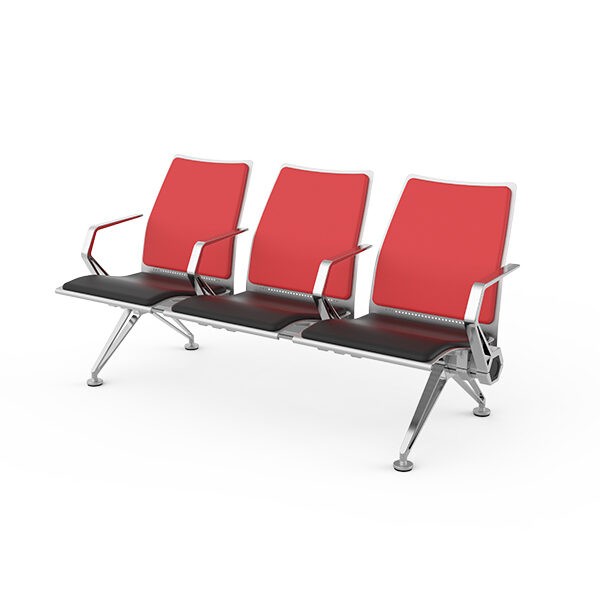
In FERMA UPHOLSTERY LS-535XB, Leadcom Seating repeats a common structural profile across layouts. Its seat and back use perforated steel with upholstered padding, while the beam is powder-coated aluminum. Across configurations, die-cast aluminum arms and legs work with aluminum brackets to maintain a consistent visual rhythm. The model uses straight, back-to-back, and cluster arrangements for varied seat counts.
Across the row, a central arm changes center-to-center spacing between seats from 535 to 575 mm. The 890 mm overall height establishes the back line across modules; the seat is 440 mm high, armrests 620 mm, and depth 665 mm. These dimensions provide reference points for checking seat spacing, armrest height, and back alignment across the proposed layouts. Repeating a common back height and arm profile can make different seat counts read as parts of one system.
Control Variation Without Flattening the Layout
In tandem seating, consistency does not require every group to be identical. A straight run may define a circulation edge, while a back-to-back arrangement serves travelers approaching from two sides. A cluster can respond to a wider concourse. Their orientation changes the visual composition, but the shared beam, arms, and seat profile can hold the scheme together.
The FERMA Steel, FERMA PU, and FERMA Upholstery versions share aluminum structural components, while their seat and back materials differ. A project can compare these surfaces for cleaning, comfort, and location while retaining related support forms. Mixing variants still requires deliberate finish control. Differences in texture and reflectance may be more obvious under station lighting than in a catalogue photograph.
A finish schedule should name each visible part separately: seat surface, back surface, arm, leg, beam, bracket, and optional table. Color codes or approved physical samples are more useful than labels such as gray or silver. If upholstery is used, fabric direction and seam placement can affect how adjacent modules appear. Replacement parts should be ordered against the same schedule so later repairs do not introduce noticeable mismatches.
Configuration drawings must account for end conditions. A three-seat run may have a different distribution of legs and arms than a pair of two-seat units placed together. The intervals between supports should look intentional, and any exposed beam at the end needs an approved treatment. Junctions in back-to-back groups should also be reviewed from both approach directions.
Manufacturing consistency is visible in small tolerances. Adjacent backs that sit at different angles or arms that vary in height make a repeated design appear uneven. A single-seat sample cannot show these tolerances; several modules and one junction reveal them. The drawing can set reference lines for backs, arms, and beams, while an installed sample checks how those lines read across floor and lighting conditions. That standard can be checked during delivery.
Review the Space as One Composition
The test of aesthetic consistency is a layout drawing, not an isolated product image. Elevations show whether back lines align across short and long runs; plans show how clusters relate to straight rows and circulation routes. A sample bay can reveal changes in upholstery color under daylight and artificial light, as well as the prominence of arm and bracket details.
Waiting area seating is often expanded in phases. Recording the selected component family, finish codes, dimensions, and accessory positions gives later additions a reference. It also exposes where a proposed substitution would change visual rhythm even if the seat count remains correct.
A manufacturer can supply repeated components, but the final appearance depends on how those components are arranged and specified for the room. Across different seat counts, the strongest visual link is a controlled pattern of proportions, supports, surfaces, and end details that remains recognizable from every main approach.