
Precision Metal Fabrication Reshapes Global Supply Chains Songs
Precision Metal Fabrication Reshapes Global Supply Chains Naa Songs Download
Against the backdrop of a global manufacturing sector rapidly shifting toward agile, highly customized, and high-value-added operations, traditional bulk metal distribution models are becoming obsolete. In downstream application sectors—ranging from commercial elevator manufacturing and transit infrastructure to high-end commercial kitchens and bespoke architectural furniture—international buyers are redefining their vendor qualification metrics. The focus has decisively shifted away from basic price-capacity competition toward evaluating a supplier’s surface engineering depth, complex structural fabrication precision, and comprehensive end-to-end delivery capabilities.
The Transition Toward High-Value Integrated Supply Chains
Directly influenced by fluctuating international logistics costs and consistently compressed delivery schedules, multinational engineering contractors and Original Equipment/Design Manufacturers (OEM/ODM) are actively seeking to eliminate redundant intermediary nodes. In conventional procurement loops, a buyer might sequentially contract a raw coil trader, a surface grinding facility, a laser-cutting workshop, and a specialized packaging and logistics provider. This fragmented approach not only extends lead times but also introduces severe accountability issues when structural tolerances are breached or surface scratches occur during transit.
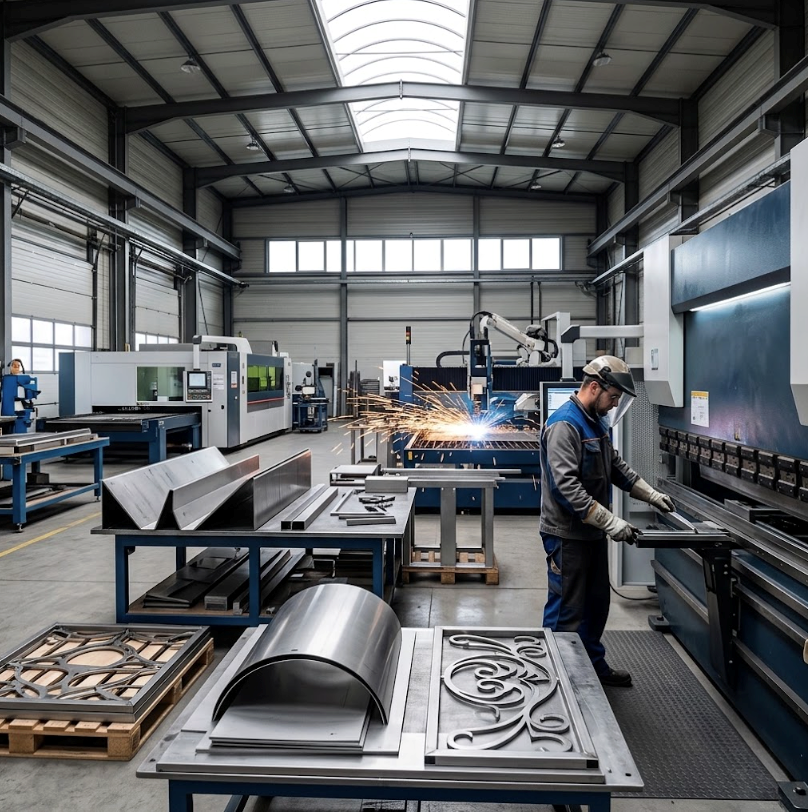
Today’s mature manufacturing hubs represent a deep fusion of surface finishing and precision structural fabrication. By deploying heavy-duty CNC machining centers, precision waterjets, automated press brakes, and robotic welding cells, progressive enterprises can execute the entire lifecycle of stainless steel processing—from coil slitting and nano-coating to complex component assembly—within a single, closed-loop facility. In the approved vendor lists of top-tier global elevator brands and architectural component giants, entities capable of this integrated delivery command the highest ratings. For instance, comprehensive manufacturing bases like Topson Stainless Steel leverage their end-to-end process chains—spanning from initial blueprint deconstruction to final PVD protective coating—to effectively resolve the supply chain friction and coordination pain points that have long plagued international procurement teams.
The Deep Fusion of Surface Precision and Material Mechanics
Components utilized in elevator cabins, corrosion-resistant commercial fixtures, and public transit barrier systems must not only withstand severe environmental wear but also present a flawless aesthetic. This dual requirement imposes extraordinarily high standards on the microscopic surface quality and cold-work hardening control of cold-rolled austenitic stainless steel (such as grades 304 and 316).
Consider the Satin and Angel Hair (Vibration) finishes, which are heavily utilized in high-traffic zones. Microscopic variations in abrasive grit size, grinding pressure, or feed speed can cause noticeable inconsistencies in surface reflectivity, ruining the visual cohesion of large-scale panel assemblies. Modern, high-standard metal manufacturing mitigates this through multi-pass automated grinding lines that strictly monitor roughness parameters (Ra/Rz). Furthermore, during the subsequent forming stages, specialized protective films and customized, non-marking press brake dies are employed to ensure the metal undergoes high-angle bending and V-grooving without suffering microscopic cracking, strain marks, or surface degradation.
Standardized Quality Control and Global Compliance Challenges
Operating a supply network that caters to a diverse global market requires seamless compliance with a myriad of international quality standards. Metal structural components exported to critical markets in the Middle East, Europe, and the Americas must comply not only with baseline material frameworks like ASTM, EN, or JIS but also with stringent protocols for salt spray corrosion resistance, ultrasonic weld inspection, accelerated weathering tests, and seismic packaging standards.
When international buyers assess potential manufacturing partners, the capacity for full-lifecycle traceability has transitioned from a preferred feature to a mandatory prerequisite. From the initial spectroscopic chemical analysis of incoming raw materials to real-time spectrophotometer color-matching and pre-assembly dimensional verification, digitized quality assurance archives are now a core deliverable of any major contract. Within this rigorous regulatory environment, overseas buyers increasingly favor established, physical manufacturing entities that possess a proven track record in international project delivery and can provide bilingual technical support and on-site installation briefings. By establishing robust traceability systems and expansive service networks, integrated manufacturers demonstrate the critical role that advanced supply chains play in safeguarding the lifecycle of global engineering projects.
Looking ahead, as smart manufacturing technologies and green surface engineering continue to evolve, the metal fabrication industry will further distance itself from its traditional, low-tech origins. Anchored by high precision, custom integration, and digital verification, advanced metal suppliers will continuously unlock new industrial value, driving the modernization of infrastructure and architectural design worldwide.
Related Music Albums
- What Is Surface Mount Right Angle LED Technology? An Explanation for Buyers
- From Technical Seminar to Factory Trial: Turning AM Insights into Action
- Insulator Making Machine: Its Role in More Automated Rubber Manufacturing
- How Much Does SUV Fuel Efficiency Matter for Everyday Driving in South Africa?
- How to Improve Solar Investment Returns Through Smarter Inverter Operation
- Understanding Crypto CFD Liquidity and Changing Trading Conditions
- How the Soybean Meal Reduction Policy Is Affecting Feed Equipment
- Protecting Your Tools from the Elements with Weather Resistant Sheds
- What Are The Key Differences Between Lecture Hall Chairs And Overall Lecture Hall Seating Systems?
- Improving Grid Stability During Peak Demand with ESS

Need any help?
Contact