
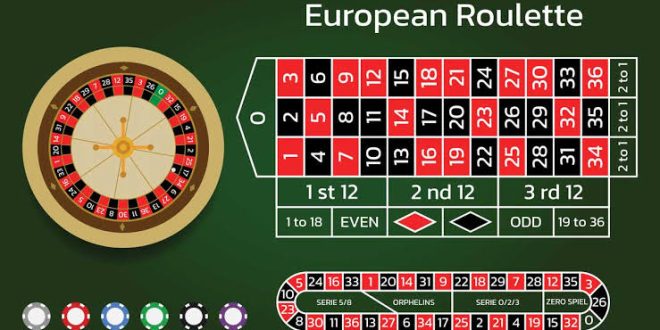
Roulette is easy to recognize but easy to misunderstand. The wheel, ball, and numbered table make the basic idea obvious, yet the actual experience changes depending on the wheel version, the type of bet placed, and whether the player is choosing a single number or covering a much larger group.
Those differences matter because payout size and probability move in opposite directions. A straight-up bet can pay far more than red or black, but it also wins far less often. Understanding that trade-off, along with the house-edge difference between European and American roulette, is more useful than relying on any betting system or lucky-number pattern.
How the Wheel and Table Actually Work
European roulette uses a wheel with 37 pockets, numbered 0 through 36. American roulette adds a second zero pocket, 00, bringing the total to 38. That single extra pocket looks minor but changes the math meaningfully: it lowers the odds of any specific outcome slightly while keeping payouts the same, which raises the house edge from about 2.70% on European wheels to about 5.26% on American ones, roughly double.
Players wanting a closer look at the roulette layout can find more information on the numbered grid, betting areas, and common roulette formats. Checking which wheel version is in use remains one of the simplest ways to compare the underlying odds before placing a chip, and many online casinos offer European and American versions side by side.
Inside Bets Cover Specific Numbers
Inside bets are placed directly on the numbered grid and cover a small, specific set of numbers, which is why they carry the highest payouts alongside the lowest odds of landing.
| Bet Type | Numbers Covered | Payout |
| Straight up | A single number | 35 to 1 |
| Split | Two adjacent numbers | 17 to 1 |
| Street | A row of three numbers | 11 to 1 |
| Corner | Four numbers meeting at a point | 8 to 1 |
| Six line | Two adjacent rows (six numbers) | 5 to 1 |
Each payout is set slightly below the true odds of winning, which is why standard inside bets on a European wheel produce the same 2.70% house edge despite covering different numbers of pockets.
Outside Bets Cover Broader Categories
Outside bets sit around the edge of the number grid and cover much larger groups of numbers, trading a smaller payout for a meaningfully higher chance of winning on any given spin. Red or black, odd or even, and high (19–36) or low (1–18) are the simplest outside bets, each paying even money, 1 to 1, on a win.
Dozens and columns split the numbers into three groups of twelve, paying 2 to 1 when the ball lands within the chosen group. These sit between the extremes: a better chance of winning than a single-number bet, but a lower payout than any inside bet offers.
European Wheels Also Support Announced Bets
Beyond the standard inside and outside bets, European and French roulette tables often offer a third category called announced or call bets, grouped by where the numbers sit on the wheel itself rather than on the table layout. Voisins du Zéro covers the numbers physically neighboring zero on the wheel, Tiers du Cylindre covers the third of the wheel directly opposite zero, and Orphelins covers the remaining numbers left over between those two groups.
These bets are placed as a set rather than individually, meaning a single announced bet actually covers several numbers at once, each with its own predetermined chip distribution. They exist because experienced players often think in terms of the wheel’s physical layout rather than the table’s printed grid, and having a shorthand for those wheel-based groupings saves placing a dozen individual chips by hand.
A Few Practical Tips Worth Knowing
Choosing European over American roulette when both are available is one of the simplest ways to reduce the house edge without changing how the game is played. Betting systems, by contrast, only change stake size and do not alter the probability of the next spin. A few roulette-specific points are more useful:
- Check whether the wheel uses one zero or two.
- Compare inside bets by payout size and hit frequency.
- Treat doubling systems as stake progression, not an odds advantage.
Mixing inside and outside bets changes the pattern of wins and losses, but it does not create a mathematical edge over the wheel.
The Numbers Do Not Change, Only the Bet Does
On a standard European wheel, conventional inside and outside bets generally carry the same 2.70% house edge. What changes from bet to bet is the trade-off between how often the wager wins and how much it pays when it does.
Special rules or non-standard bets can change that calculation, but no betting pattern makes the wheel remember previous spins. Understanding the wheel version, payout structure, and probability behind each bet is a more useful foundation than memorizing any system.