
A lecture room is more than a collection of individual seats. Audience seating refers to the broader arrangement in which chairs, desks, aisles, circulation routes, sightlines, and structural supports work together as one environment. This distinction matters when comparing individual furniture with a coordinated system. Leadcom seating provides one example of how educational furniture can integrate seating, writing surfaces, movement, and floor planning rather than treating each element separately.
Individual Chairs And Integrated Systems
A lecture hall chair is primarily judged by its seat, backrest, arm support, mechanism, and materials. These elements determine basic comfort and physical support, but they do not explain how the furniture interacts with the rest of the room. A chair can perform well on its own while still creating limitations if row spacing or desk placement is poorly planned.
A seating system takes a broader view. It considers how units are fixed or arranged, how students enter and leave rows, where writing surfaces sit, and how many users can occupy a given floor area. This approach becomes particularly valuable in large educational facilities where a small dimensional difference can influence hundreds of seats.
The distinction is mainly one of scope: an individual chair focuses on its own ergonomic and structural characteristics, while a seating system considers how those elements interact with the wider room layout.
Comfort And Ergonomic Considerations
Individual comfort begins with the relationship between seat height, depth, cushioning, and back support. Students may remain seated for several hours, so a supportive shape can be more useful than excessive softness. Material resilience also matters because classroom furniture receives repeated use throughout the academic year.
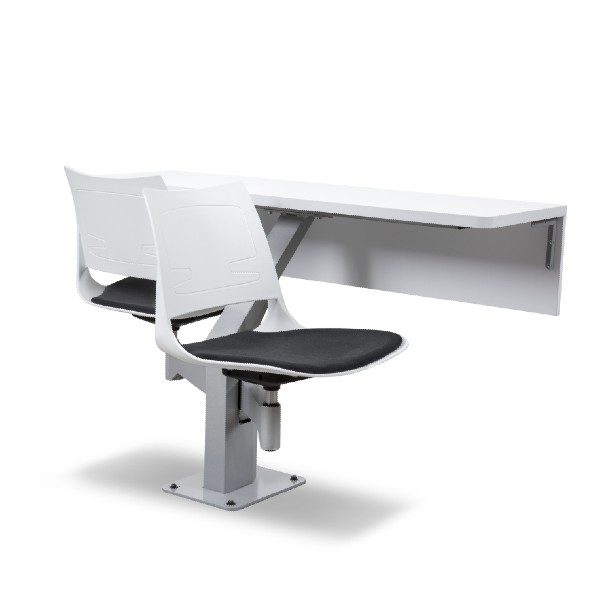
Integrated systems add another ergonomic consideration: the position and movement of the writing surface. Titan LS-420, for example, uses a PP back and padded PP seat alongside a 25 mm laminated particle-board table top. Its 360-degree swivel seat and pivoting aluminum arm allow students to adjust their orientation, creating more opportunities for interaction between rows.
Such flexibility demonstrates why audience seating should be assessed according to both physical comfort and the activities taking place around the seat.
Fixed Layouts And Flexible Movement
Traditional lecture chairs are often arranged in fixed rows, which provides predictable alignment and straightforward capacity planning. This format can suit rooms dedicated mainly to presentations, examinations, or formal instruction. The downside appears when teaching methods require students to turn toward one another or interact across adjacent rows.
A more flexible configuration can support collaborative instruction without requiring the entire room to be rearranged. Titan LS-420 is designed for straight or curved rows and can be installed on stepped or flat floors. Its pivoting structure gives students greater freedom to rotate and move their working position while remaining within the overall seating arrangement.
Flexibility should still be evaluated against maintenance, floor structure, room size, and teaching habits rather than treated as an advantage in every situation.
Space Planning And Capacity
A chair specification rarely tells the whole story about capacity. Row pitch, aisle dimensions, desk projection, access routes, and the geometry of the room all affect how many students can be accommodated. Increasing seat numbers without reviewing circulation may create a congested environment.
System-level planning also makes it easier to compare different layouts before installation. Straight rows may maximize visual consistency, while curved configurations can alter sightlines and interaction patterns. A suitable arrangement depends on the room’s proportions, teaching format, and expected occupancy rather than on seat count alone.
This is where audience seating becomes a planning discipline rather than simply a furniture category.
Materials, Structure, And Maintenance
The construction of a lecture chair influences durability, but system components must also withstand forces generated by repeated movement. Steel supports, pivot mechanisms, desk connections, and surface finishes can experience different types of wear. Each component should therefore be considered in relation to its frequency of use.
Titan LS-420 combines cold-rolled steel stanchions and bases with an aluminum rotation pivot. The table surface uses a laminated particle board with a 25 mm thickness, while the seat incorporates PP with padding. These specifications illustrate how multiple materials can be assigned to different functional roles instead of relying on a single construction method.
Maintenance planning should cover cleaning access, hardware inspection, replacement requirements, and the availability of compatible components throughout the furniture’s expected service period.
Adaptability And Long-Term Value
Educational spaces rarely remain completely static. A lecture hall may eventually accommodate hybrid instruction, collaborative seminars, examinations, or interdisciplinary activities. Furniture that supports more than one teaching pattern can give the room greater operational flexibility.
That does not mean every classroom requires a movable or highly complex system. A conventional fixed arrangement may remain more appropriate where the room has a narrow academic purpose. The important question is whether the selected configuration matches both current operations and reasonably foreseeable changes.
Leadcom seating can be reviewed as one reference when comparing integrated educational furniture, but the decision should ultimately rest on the room’s architecture, student requirements, maintenance expectations, and teaching objectives.
Conclusion
The difference between an individual lecture chair and a broader seating system lies in how many design factors are considered together. A chair emphasizes personal support and material performance; a system connects those qualities with desks, movement, circulation, capacity, and spatial organization. Leadcom seating demonstrates how these elements can be combined within an educational configuration, while effective specification still depends on the particular lecture hall and its intended use.