
Before an automated workstation receives its first sample, the surrounding materials already determine whether the intended sequence is ready to run. Primary tubes, transfer tips, reagent containers and PCR vessels occupy different positions in that sequence.
Preparing PCR supplies for a high-throughput laboratory therefore involves more than filling the final reaction rack. The material arrangement has to connect sample loading, purification and reaction setup without leaving an unresolved interface between the operations.
Begin with the Primary Tube Interface
The original sample container meets the instrument before the purified DNA reaches a PCR vessel. Tube format belongs to this loading interface, while the eventual reaction container belongs to another operation. Keeping the two roles separate avoids treating a consumable suitable for amplification as evidence that the incoming sample container will fit the loading arrangement.
For an automated DNA extraction machine, the relevant container requirements come from the equipment’s supported loading configuration. Capacity alone is not a complete description: the format accepted at the sample station must also be established.
The same physical vessel does not necessarily accompany the material through every subsequent step of purification and reaction preparation. Container capacity, tube dimensions and the accepted loading position are separate attributes, so a volume label alone cannot complete the physical compatibility check.
A preparation list can consequently distinguish sample containers from reagent tubes and final reaction vessels. Each item needs a location and an assigned operation, so the materials available at one station are not mistakenly counted as supplies for another. The contribution of PCR supplies becomes visible when the final reaction format is connected back to the transfers that will fill it.
Track the Liquid Through Transfer and Setup
A transfer moves a defined material from a source position to a receiving position; it also creates a demand for the appropriate dispensing consumable. The material may be a specimen, an extraction reagent, an eluate or a PCR reagent. Distinguishing these roles provides a clearer basis for preparation than treating every liquid-handling step as an identical operation. Source and receiving containers can therefore have different formats even within the same programmed sequence.
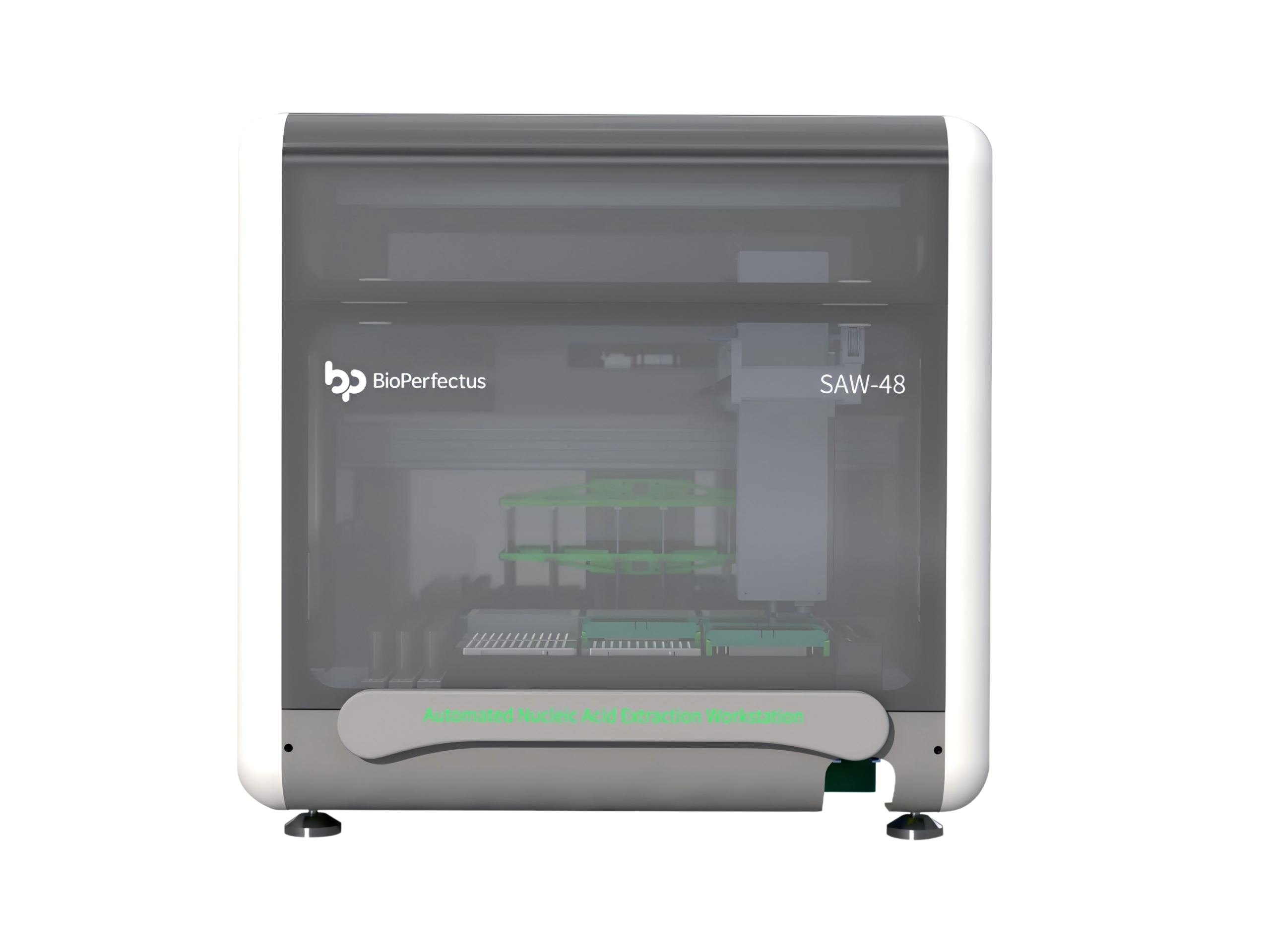
Sample loading, purification and PCR setup are integrated in the Automated Nucleic Acid Extraction Workstation SAW-48, a BioPerfectus instrument that moves material from primary sample tubes to PCR-ready tubes. That integration identifies which operations meet within the workstation. It does not eliminate the separate functions of sample containers, dispensing materials and the vessels receiving the prepared reaction.
The supply arrangement around an automated DNA extraction machine therefore needs to follow the actual transfer sequence. Reagent containers belong at the operations that draw from them, and receiving vessels belong where the prepared material is delivered. A complete layout connects those positions to the selected program instead of assuming that an available rack of consumables is sufficient.
Give Cooling and Separation Their Own Roles
Different stations can have different environmental requirements because they hold different materials and perform different operations. Extraction, reagent storage during use and reaction setup are not interchangeable tasks. Their arrangement belongs in the workflow assessment alongside the consumable list, particularly when a workstation joins operations that would otherwise occur at separate benches.
In the SAW-48, BioPerfectus separates extraction and liquid dispensing areas and provides cooled reagent and PCR setup stations. Its contamination-control provisions include UV disinfection, HEPA filtration, an electrostatic filter and filter pipette tips.
These are specified features of the workstation, with distinct roles in the operating configuration rather than a promise that every contamination event is impossible. Filtered tips accompany dispensing; chamber filtration addresses the surrounding operating air space.
Consumable preparation has to respect those assigned roles. The location of a reagent container and the destination of a transferred liquid are part of the arrangement, not incidental details added after loading. Equipment features provide operating conditions within which the laboratory organizes its materials; suitable supplies and a defined procedure still remain necessary parts of the run.
The reagent station operates at 4–15°C and the PCR setup station at 4–8°C. These ranges describe conditions at preparation stations, not the temperatures used later for amplification. Connecting a cooled station to its actual material clarifies why preparation conditions and the downstream thermal program cannot be treated as the same operating requirement.
Bring the Stations into a Ready Batch
Batch readiness links the individual interfaces into an executable sequence. The SAW-48 supports specified primary tube formats and PCR tubes, so checking each station against the chosen program can reveal a missing or mismatched item before the run begins. This review concerns the complete material route rather than the availability of one familiar consumable type.
Receiving vessels and dispensing materials occupy different points in the BioPerfectus workstation’s sequence, so PCR supplies require checks at both interfaces. The sample and reagent requirements remain tied to their own steps. An automated DNA extraction machine may connect several operations, but the laboratory’s preparation record still needs to distinguish the inputs and outputs of each one.
A ready high-throughput workflow brings materials, locations and program requirements into agreement. The useful check follows the sample through loading, extraction and reaction setup, confirming that each operation has a suitable input and a prepared destination. Automation becomes operationally usable when the consumables and the intended sequence are ready together, before the batch enters the workstation.