
Modern industrial automation and edge computing systems demand deterministic compute bandwidth alongside strict power boundaries. Embedded hardware designers selecting the STM32H743VIT6 high-performance 32-bit microcontroller (MCU) gain access to an Arm Cortex-M7 core operating at frequencies up to 480 MHz. This architectural class bridges the gap between conventional microcontrollers and power-hungry application microprocessors.
Architectural Compute Density and Memory Hierarchy
Operating at 480 MHz requires an internal memory hierarchy capable of feeding instructions without latency penalties. STMicroelectronics addresses this computational bottleneck by integrating 2 MB of dual-bank Flash memory alongside 1 MB of SRAM. The on-chip memory architecture includes tightly coupled instruction and data memories (ITCM and DTCM) to guarantee zero-wait-state execution for critical control loops.
The device’s memory architecture and error-handling features should be evaluated against the manufacturer’s documentation when designing firmware update and data-integrity mechanisms. These hardware-level reliability features make the device suitable for mission-critical industrial drives and functional safety environments.
Internal interconnect matrix designs route traffic across multiple master and slave peripherals simultaneously. Dual-precision floating-point hardware accelerates complex motor control transformations, digital signal filtering, and sensor fusion algorithms. Dedicated direct memory access (DMA) controllers offload bulk data transfers from the CPU core, preserving processing headroom for deterministic control tasks.
Regulating Point-of-Load Rails via Step-Down Buck Converters
Sustaining peak processing capability places rigorous demands on board-level voltage regulation stages. Dynamic current transients during high-frequency execution can induce voltage sags if the power delivery network lacks sufficient transient response. System stability depends on feeding the core, analog peripherals, and input/output banks from stable, low-noise supply rails.
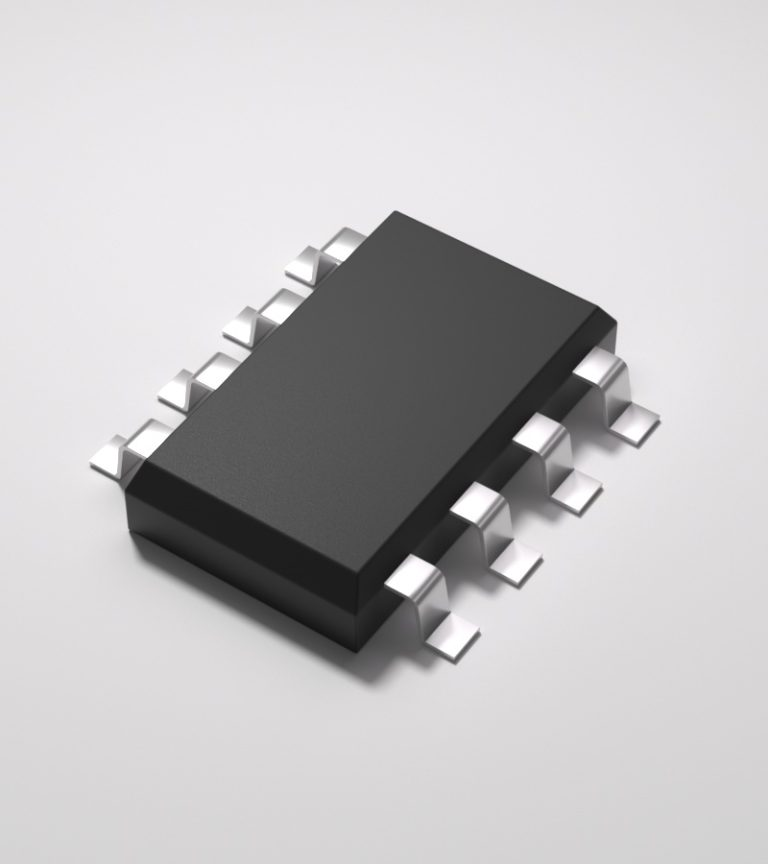
Point-of-load regulation becomes critical when stepping down raw 12V or 24V industrial bus voltages. Implementing an efficient switching regulator such as the TI TDA22590 ensures steady 3A step-down voltage conversion for the controller and auxiliary subsystems. Housed in an 8-pin SOIC package with a 3.90 mm width, this adjustable buck converter minimizes board footprint.
Thermal performance remains an essential design factor across harsh operational environments. The TDA22590 buck regulator supports an extended operating temperature range from -40°C to +150°C, preventing thermal derating near crowded processing clusters. Pairing efficient switching regulation with local decoupling capacitors suppresses ripple and protects sensitive 16-bit analog-to-digital converters from high-frequency switching noise.
Selecting appropriate passive components around the regulator circuit directly influences efficiency and electromagnetic emissions. Designers calculate inductor sizing and output capacitance based on load step response and voltage ripple. Proper compensation loop tuning ensures rapid recovery from dynamic load steps when the microcontroller transitions between low-power sleep states and maximum computational throughput.
High-Speed Interface Routing and PCB Layout Constraints
High-speed peripheral routing presents another integration challenge on dense multilayer circuit boards. The controller integrates Chrom-ART graphics acceleration, dual CAN FD controllers, high-speed USB OTG, and an Ethernet MAC within a 100-pin LQFP package. Maintaining differential impedance matching on Ethernet and USB lines prevents packet loss across electrically noisy factory environments.
Mixed-signal partitioning separates sensitive analog inputs from fast-switching digital busses. Placing high-frequency ceramic bypass capacitors immediately adjacent to individual power pins minimizes parasitic inductance along supply traces. Establishing a continuous, unbroken ground reference plane beneath high-speed signal lines prevents crosstalk and preserves measurement accuracy for multi-channel sensor acquisition.
Physical packaging dimensions influence both assembly yield and thermal dissipation efficiency. The 14×14 mm footprint of the 100-pin LQFP provides adequate lead pitch for automated optical inspection and surface-mount assembly. Robust mechanical lead compliance absorbs mechanical stress from thermal cycling, enhancing long-term joint reliability in industrial machinery.
Sourcing Verification Through an Authorized MCU Supplier
Long-term commercial viability requires evaluating production lifecycle status and component availability early in the development cycle. Specifying the STM32H743VIT6 high-performance 32-bit microcontroller (MCU) requires coordinating with distribution partners to forecast delivery schedules, lead times, and packaging options. Unforeseen production bottlenecks can stall industrial deployments if bill-of-materials sourcing remains unverified.
Counterfeit mitigation represents a primary concern when procuring active semiconductor devices from open markets. Engineering and procurement teams protect production lines by relying on a qualified MCU supplier capable of providing rigorous traceability. Verified chain-of-custody documentation ensures that incoming silicon matches factory performance ratings and environmental compliance standards.
Ensuring Component Authenticity and Traceability
Working with established distribution networks eliminates the risks of receiving remarked or substandard components. Unibetter sources and procures electronic components from franchised sources to guarantee 100% authentic, quality-assured and brand-new electronic components. This disciplined procurement model provides original manufacturer certificates of conformance, lot code traceability, and moisture sensitivity level packaging compliance.
Direct access to global inventory channels enables original equipment manufacturers to mitigate volatile lead-time fluctuations. Unibetter distributes a wide range of electronic components across processing, power conversion, and passive categories to streamline bill-of-materials fulfillment. Consolidating microcontrollers and power management ICs through a single channel reduces administrative friction and logistics overhead.
Optimizing Procurement Costs and Production Planning
For industrial automation projects and competitive electronic manufacturing services, strategic cost control is still essential. Their ability to help clients find and purchase necessary electrical components at reduced prices is one of their service strengths. Project timelines are protected against unforeseen market allocations by combining proactive inventory allocation with thorough market knowledge.
Engineering teams safeguard complex product designs by coordinating with an established MCU supplier throughout production ramp-up. Unibetter helps procurement specialists align component delivery schedules with manufacturing cycles, preventing costly line shutdowns. Reliable distribution partnerships ensure that high-performance designs scale smoothly from prototype validation into volume manufacturing.
Establishing robust hardware architecture, verified power regulation topologies, and authenticated supply pipelines builds resilient industrial systems. Harmonizing compute density with reliable component procurement ensures that advanced embedded devices deliver continuous, dependable performance in demanding field environments.